You’re tired, but your mind is still running.
You replay conversations, think about tomorrow, and turn small problems into big ones the moment your head hits the pillow.
That’s why overthinking at night feels so frustrating: your body wants sleep, but your brain keeps acting like it still has work to do.
In this guide, you’ll learn how to stop overthinking at night using methods that actually work in real life—not generic advice like “just relax” or “clear your mind.”
You go to bed physically tired, expecting to finally rest, but the moment your head touches the pillow your mind starts working against you. Thoughts begin to appear one after another, conversations replay in your head, future scenarios take shape, and problems that seemed small during the day suddenly feel heavier and more urgent.
What makes this situation even more frustrating is that you are aware of what is happening, yet you cannot seem to stop it. The harder you try to shut your mind off, the more active it becomes, creating a loop that delays sleep and leaves you mentally drained before the next day even begins.
This is not a sign of weakness or lack of discipline, but rather a predictable pattern caused by how your brain processes information when external stimulation disappears. During the day, your attention is constantly occupied, but at night, when everything slows down, your mind finally has space to process everything that has been left unresolved.
If you do not understand how this pattern works, it can easily become a habit that affects your sleep quality, your focus, and your overall mental clarity. If you want know more about why you overthink everything, read this post why you overthink everything
However, once you learn how to manage it correctly, you can reduce overthinking significantly and regain control over your mind.
In this guide, you will learn exactly how to stop overthinking at night using practical strategies that reduce mental noise, improve your ability to relax, and help you fall asleep naturally without relying on distractions or temporary fixes.
Why You Overthink More at Night
Overthinking at night is not random. During the day, your brain is distracted by tasks, conversations, and external input. But at night, everything slows down. That’s when your mind finally has space to process unresolved thoughts.
This creates a perfect storm:
- No distractions
- More mental space
- Accumulated stress from the day
According to research from Harvard Medical School, the brain tends to process emotional experiences more intensely during rest periods, which can increase rumination and overthinking at night.
👉 https://www.sleepfoundation.org/how-sleep-works
What makes nighttime overthinking worse is not just stress itself, but the lack of distraction. During the day, your attention is pulled outward by work, screens, conversations, and tasks. At night, that external input drops, and whatever felt manageable before can suddenly feel loud and urgent. That is why overthinking often feels strongest right before sleep rather than in the middle of the day.
WHY OVERTHINKING GETS WORSE AT NIGHT
Overthinking feels stronger at night for three specific reasons:
- Mental backlog
During the day, your brain suppresses unresolved thoughts because you’re busy. At night, they resurface. - Lack of external input
No phone, no conversations, no stimulation. Your brain fills the silence with internal noise. - Elevated cortisol cycles
Stress hormones don’t shut off instantly. If your day was intense, your brain stays in problem-solving mode.
That’s why trying to “force sleep” doesn’t work. You’re not dealing with sleep—you’re dealing with an active mind.
Research published by the National Institutes of Health shows that increased mental activity before sleep significantly delays the onset of sleep and reduces overall sleep quality, reinforcing the idea that an active mind directly interferes with rest.
👉 https://www.ncbi.nlm.nih.gov/pmc/articles/PMC5449130/
Understanding this mechanism is essential because it shifts the problem from being something random to something predictable and manageable.
Why Trying to “Stop Thinking” Makes It Worse
Most people approach this the wrong way because they try to force their mind to stop but it doesn’t work.
The brain doesn’t respond well to suppression. In fact, trying to suppress thoughts often makes them stronger.
This is known as the “rebound effect.” It´s better learn how to stop overthinking at night.
Studies from the National Institutes of Health (NIH) show that suppressing thoughts can increase their intensity and frequency.
👉https://pmc.ncbi.nlm.nih.gov/articles/PMC12689852/
WHAT TO DO WHEN YOU’RE OVERTHINKING RIGHT NOW
If your mind is racing right now, do this:
- Sit up in bed (don’t stay lying down)
- Write down everything that’s looping in your head
- Pick ONE thought and define the next action (even if it’s tomorrow)
- Close the loop mentally
Your brain doesn’t want answers—it wants closure.
Once it feels that something is handled, it stops repeating it.
If this is happening to you tonight, start here:
Get out of the loop instead of trying to “win” against it. Sit up, write down what is repeating in your mind, and choose one tiny next step for tomorrow. You do not need to solve your whole life before sleep. You only need to stop your brain from feeling that everything is still open.
The Real Cause: Mental Overstimulation During the Day
Most people try to solve nighttime overthinking without addressing its root cause, which is the level of stimulation their brain experiences during the day. Modern environments are designed to keep your attention constantly engaged, exposing you to endless streams of information that your brain cannot process in real time.
Social media, fast-paced content, notifications, and multitasking create a continuous loop of stimulation that raises your brain’s baseline level of activity. As a result, when you finally remove these inputs at night, your brain does not immediately slow down, but instead continues generating activity internally.
This is why your mind feels even more active when everything around you becomes quiet.
Reducing this overstimulation is one of the most effective ways to lower mental noise and improve your ability to relax at night. A structured approach such as a dopamine detox can help reset your brain’s response to stimulation and reduce unnecessary cognitive activity.
👉 If you want to understand how to reduce mental overstimulation, read:
/dopamine-detox/
The Real Cause of Night Overthinking
Overthinking at night is not really about the night. It’s about everything you didn’t resolve during the day.
When you’re busy, your brain is occupied with tasks, conversations, and distractions. But when the day ends and external input disappears, your mind finally has space to process what’s been left unfinished.
That’s when overthinking begins. It’s not random. It’s a delayed reaction. Most night overthinking is triggered by four underlying factors:
- Unresolved decisions
When you avoid making decisions during the day, your brain keeps them open as “unfinished loops.” At night, it tries to close them. - Lack of mental closure
If your day ends without clarity—no plan, no reflection, no structure—your mind keeps running in the background trying to organize everything. - Overstimulation
Constant input (social media, videos, notifications) keeps your brain in a high-alert state. When you suddenly stop, your mind doesn’t calm down—it rebounds with internal noise. - Lack of control during the day
If your day feels reactive instead of intentional, your brain tries to regain control at night by analyzing everything that happened.
This is why trying to “calm your mind” at night often fails. You’re not dealing with a night problem. You’re dealing with accumulated mental pressure.
Research in cognitive psychology shows that the brain seeks closure and resolution, especially during periods of rest, which explains why intrusive thoughts become more active at night.
If you don’t fix your day, your nights won’t change.
Signs That Your Mind Is Stuck in Overthinking
Recognizing the pattern is an important step because many people normalize overthinking without realizing how much it affects them.
You replay conversations repeatedly, trying to analyze what you said or what you should have said differently, even when the situation is already over.
You imagine future scenarios, often focusing on negative outcomes that may never happen.
You feel mentally exhausted but unable to relax, as if your brain refuses to slow down.
You try to distract yourself with your phone or other forms of stimulation, which only delays the problem and often makes it worse later.
You struggle to fall asleep even when your body feels physically tired.
These signs indicate that your brain is not simply thinking, but stuck in a loop that needs to be interrupted.
How to Stop Overthinking at Night (Step-by-Step Method That Works)
Stopping overthinking does not mean eliminating thoughts, but rather changing how your brain processes and responds to them. This requires a combination of reducing mental load, controlling stimulation, and shifting your attention in a deliberate way.
Step 1: Externalize Your Thoughts Before Bed
One of the main reasons your brain overthinks at night is because it is trying to hold onto information that it perceives as important. When thoughts remain internal, your mind keeps revisiting them to avoid losing track.
Writing your thoughts down creates a clear boundary between thinking and processing. By putting your thoughts on paper, you reduce the need for your brain to keep cycling through them.
Take a few minutes before bed to write everything that is on your mind, including concerns, tasks, and unresolved ideas. This simple habit signals to your brain that it does not need to continue processing those thoughts during the night.
Step 2: Reduce Stimulation Before Sleep
If you expose your brain to high levels of stimulation before bed, it will remain active even after you stop. Scrolling through social media or consuming fast-paced content keeps your brain in a state of alertness that makes it difficult to relax.
Replacing these habits with low-stimulation activities such as reading or quiet reflection allows your brain to gradually reduce its level of activity. Maintaining this habit requires discipline, especially when the easier option is to continue consuming content.
👉 Learn how to build that discipline here:
/how-to-build-self-discipline/
Step 3: Create an Environment That Supports Sleep
Your environment plays a significant role in how your mind behaves. A space that is cluttered, noisy, or associated with stimulation makes it harder for your brain to switch into a relaxed state.
Your room should be designed to signal rest, which means minimizing distractions, reducing light, and maintaining a calm atmosphere. Over time, your brain will associate this environment with sleep, making it easier to disconnect mentally.
Step 4: Stop Trying to Control Every Thought
Trying to force your mind to stop thinking creates resistance, which often increases mental activity. Instead of fighting your thoughts, observe them without engaging.
Allow them to pass without analyzing or reacting to them. This reduces their intensity and prevents them from turning into loops.
Step 5: Shift Your Attention to Physical Sensations
When your mind becomes too active, redirecting your attention to your body can help reduce mental noise. Focusing on your breathing, your heartbeat, or the sensation of your body against the bed creates a grounding effect.
This shifts your attention away from abstract thinking and into the present moment, making it easier for your mind to slow down naturally.
👉Technique: Brain Dump. Write everything on paper before sleep.
Why it works:
Your brain loops thoughts because it fears losing them. Writing creates a sense of control and reduces cognitive load.
Why Consistency Matters More Than Motivation
Many people try these strategies for a few days and then stop when they do not see immediate results. This is one of the main reasons overthinking persists.
Your brain adapts over time, and reducing overthinking requires consistent changes in your habits and environment. Motivation may help you start, but consistency is what creates long-term results.
👉 If you struggle to stay consistent, read:
/how-to-stay-consistent/
The Connection Between Overthinking and Sleep Quality
Overthinking does not only affect how quickly you fall asleep, but also how well you sleep once you do. When your brain remains active, your nervous system stays in a heightened state that prevents deep, restorative sleep.
Research from Harvard Medical School highlights that cognitive arousal is one of the main contributors to sleep disturbances and insomnia, emphasizing the importance of reducing mental activity before bed.
👉 https://www.health.harvard.edu/sleep/why-you-cant-sleep
Improving sleep quality requires reducing both physical and mental activation.
What to Do When You Cannot Fall Asleep
If you remain in bed while your mind is active, you reinforce the association between your bed and overthinking. Instead of forcing sleep, get up and engage in a low-stimulation activity such as reading or sitting quietly.
This breaks the mental loop and allows your brain to reset before returning to bed.
Common Mistakes That Make Overthinking Worse
Trying to suppress thoughts completely instead of observing them.
Using your phone as a distraction, which increases stimulation.
Staying in bed while feeling frustrated or restless.
Expecting immediate results instead of focusing on consistency.
Avoiding these mistakes is just as important as applying the correct strategies.
Long-Term Strategy to Eliminate Overthinking
Stopping overthinking is not about finding a single solution, but about building a system that reduces mental overload over time. This includes reducing daily stimulation, building discipline, and creating an environment that supports focus and relaxation.
When these elements are combined, your brain gradually adapts and stops defaulting to overthinking.
Final Thoughts: Calm Your Mind Without Forcing It
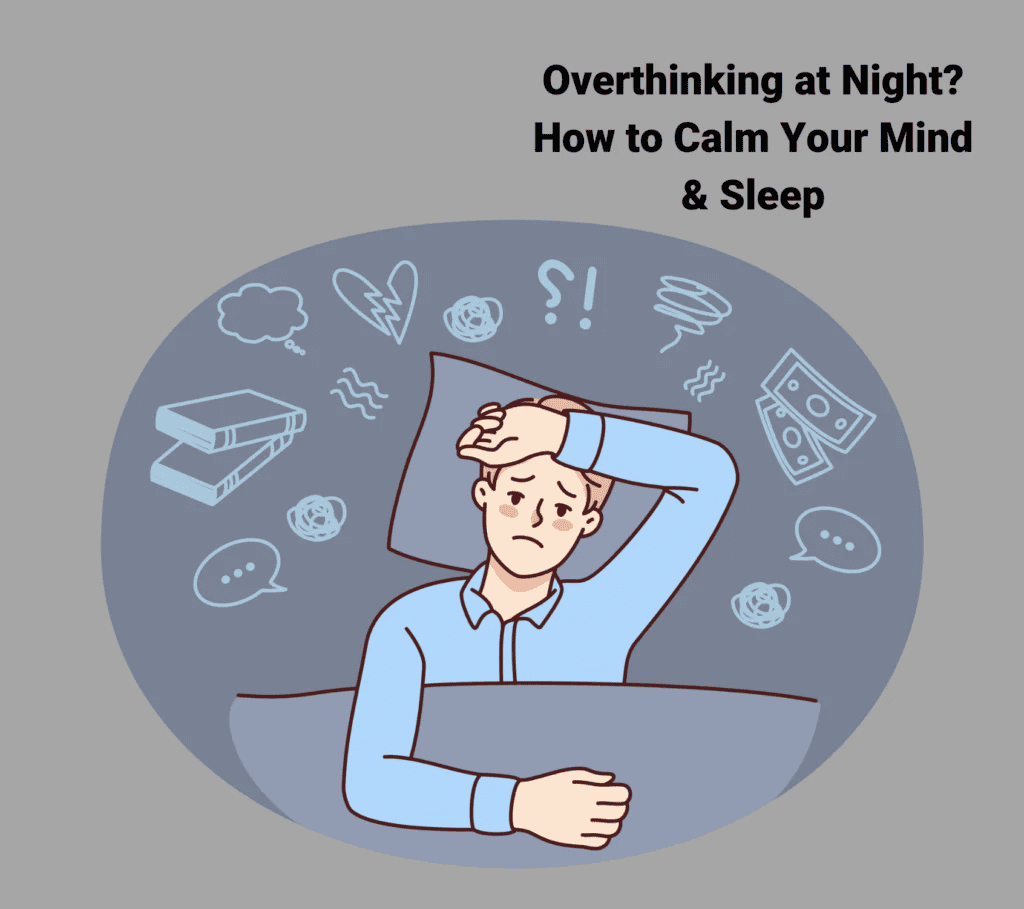
Overthinking at night is not a sign that you are weak, broken, or incapable of relaxing.
It usually means your mind is still carrying unfinished tension into a moment that requires calm.
The goal is not to force sleep. The goal is to stop giving your brain the message that everything is still unresolved.
When you reduce mental noise and create closure, sleep becomes easier because your mind no longer feels responsible for staying awake.
Pingback: How to Calm Your Mind Fast (Proven Techniques That Work)
Pingback: How to Stop Negative Thoughts (Proven Ways to Take Back Control Fast)
Pingback: Overthinking vs Anxiety: What’s the Difference
Pingback: How to Control Your Thoughts (Regain Mental Clarity)
Pingback: How to Stop Thinking About Something (Break the Mental Loop Fast)
Pingback: How to Get Thoughts Out of Your Head (Clear Mental Clutter Fast)
Pingback: Dopamine Detox: Reset Your Brain, Improve Focus & Build Discipline
Pingback: How to Be Mentally Strong (Even When You Feel Unmotivated)
Pingback: Why Do I Overthink Everything? (And How to Finally Stop It)
Pingback: Overthinking vs Anxiety: Know the Differences Today