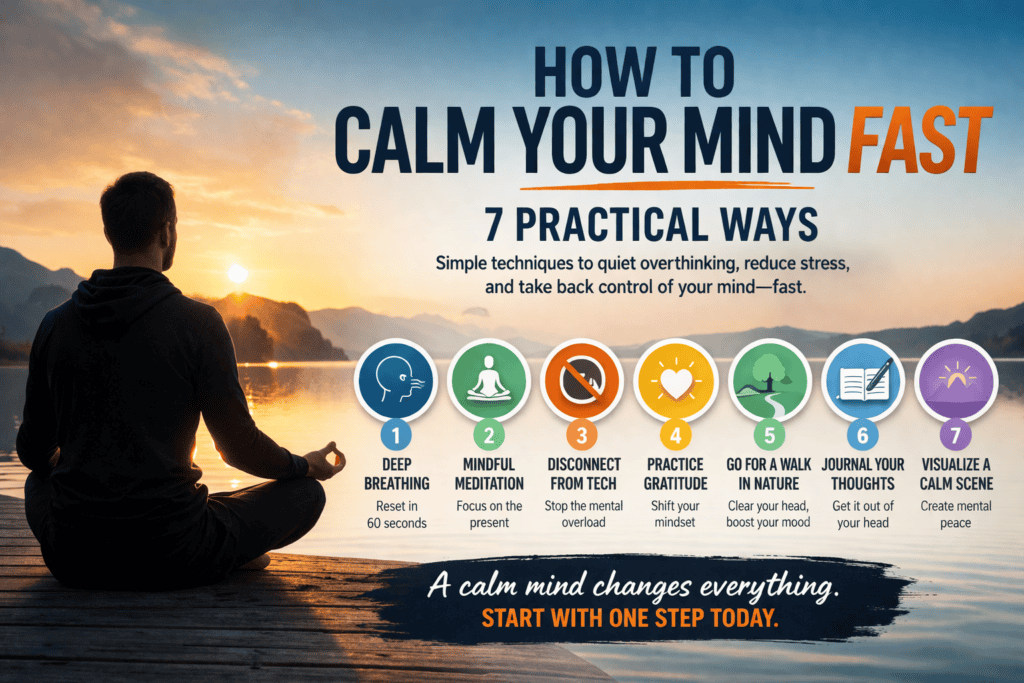
There are moments when your mind feels impossible to slow down, especially when thoughts begin to build on top of each other and create a constant sense of pressure that makes it difficult to focus, relax, or even think clearly.
It´s necessary learn how to calm your mind fast because in these situations, trying to “just stop thinking” rarely works, because the mind does not respond well to force, particularly when it is already overwhelmed or overstimulated.
Instead, calming your mind requires understanding what is happening beneath the surface and using specific strategies that help shift your attention, regulate your state, and reduce the intensity of your thoughts without fighting them directly.
While long-term change takes consistency, there are ways to calm your mind quickly by interrupting the patterns that keep overthinking active and giving your brain a different direction to follow.
Why Your Mind Won’t Calm Down
Your mind doesn’t stay busy by accident.
It’s the result of constant stimulation, unresolved thoughts, and lack of mental control.
When you’re exposed to continuous input—notifications, social media, stress—your brain doesn’t get the chance to reset.
This creates a loop:
- More stimulation → more thoughts
- More thoughts → more anxiety
- More anxiety → less control
According to research from Harvard Medical School, chronic overstimulation can affect cognitive control and increase mental fatigue.
👉https://www.health.harvard.edu/healthy-aging-and-longevity/understanding-the-stress-response
Why Your Mind Feels Overactive
An overactive mind is usually not the result of thinking too much, but of thinking in a way that lacks resolution, which creates loops that continue without leading to action or clarity.
This often happens when:
- there is uncertainty
- you are mentally fatigued
- your brain is overstimulated
- you are trying to control something you cannot
From a psychological perspective, the brain tends to increase mental activity when it perceives a lack of control, as it tries to simulate outcomes and prepare for different scenarios.
Insights from American Psychological Association show that repetitive thought patterns are often linked to attempts to manage uncertainty, even when they become counterproductive.
What Actually Helps in How to Calm your Mind Fast
Calming the mind is not about eliminating thoughts, but about reducing their intensity and changing how your attention interacts with them.
Instead of engaging with every thought, the goal is to shift your mental state in a way that naturally decreases overactivity.
1. Shift Your Focus to Your Body
One of the fastest ways to calm your mind is to move your attention away from abstract thinking and toward physical sensations, since the body operates in the present moment while overthinking usually exists in past or future scenarios.
Simple techniques such as controlled breathing, noticing physical tension, or focusing on your surroundings can interrupt mental loops and create a sense of grounding.
2. Slow Down Your Breathing Intentionally
Breathing patterns are closely connected to your mental state, and slowing your breathing can signal to your brain that it is safe to reduce alertness.
Taking slow, controlled breaths helps lower the intensity of your thoughts and creates a natural shift from a reactive state to a more stable one.
3. Reduce Incoming Stimulation Immediately
If your mind feels overwhelmed, it is often because it has been exposed to too much input, which keeps it active even when you want to rest.
Reducing stimulation, such as turning off screens, stepping away from notifications, or creating a quieter environment, can help your brain settle more quickly.
4. Write Down What Is on Your Mind
When thoughts feel overwhelming, writing them down can help externalize them, making them easier to process and less intense.
This process reduces the need to keep everything in your head and allows your brain to organize thoughts more effectively.
5. Accept the Thought Instead of Fighting It
Trying to force your mind to stop thinking often creates more resistance, which increases mental activity instead of reducing it.
Allowing thoughts to exist without reacting to them can reduce their impact over time and make it easier for them to pass naturally.
6. Change Your Environment
Sometimes the fastest way to calm your mind is to physically change your environment, since different surroundings can influence how your brain processes information.
Even a short walk or moving to a quieter space can interrupt the current mental pattern.
7. Do One Simple Task
Focusing on a simple, manageable task can help redirect your attention and break the cycle of overthinking, especially when the task requires some level of engagement without being overwhelming.
Why Most People Fail to Calm Their Mind
Most people try to calm their mind the wrong way. They try to eliminate thoughts completely. That doesn’t work.
The goal is not to stop thinking—it’s to reduce noise and regain control.
Common mistakes:
- Fighting thoughts instead of observing them
- Using distractions instead of solving the cause
- Expecting instant calm
Real mental clarity comes from control, not suppression.
Studies from the National Institutes of Health (NIH) show that cognitive overload and constant stimulation can increase anxiety and reduce mental clarity.
👉 https://pmc.ncbi.nlm.nih.gov/articles/PMC8948345/
Why Quick Fixes Sometimes Don’t Work
Many people try to calm their mind using distractions such as scrolling or watching videos, which may provide temporary relief but often maintain the same level of stimulation that caused the problem.
According to insights from Cleveland Clinic, constant stimulation can reinforce mental overactivity rather than reduce it, which explains why these approaches are often ineffective in the long term.
How to Prevent Your Mind From Becoming Overactive Again
While quick techniques can help in the moment, preventing overthinking requires addressing the underlying patterns that contribute to mental overload.
This includes:
- reducing unnecessary input
- improving mental discipline
- creating structured routines
When You Should Take Overthinking Seriously
Occasional overthinking is normal, but if it becomes persistent and begins to interfere with sleep, work, or daily life, it may indicate deeper patterns related to anxiety or stress that require more structured strategies.
Recognizing this early allows you to address the issue before it becomes more difficult to manage.
Build a Calm Mind Long-Term
Calming your mind once is useful. But building a calm mind is what changes your life.
That requires:
Final Thoughts
Calming your mind quickly is not about forcing silence, but about changing your state in a way that reduces the intensity of your thoughts and allows them to pass more naturally.
By understanding how your mind works and applying simple but effective strategies, it becomes possible to regain control even in moments when everything feels overwhelming.
FAQs
How can I calm my mind immediately?
By focusing on your breathing, reducing stimulation, and shifting your attention to physical sensations.
Why does my mind race so much?
Because it is trying to manage uncertainty or process too much information at once.
Can overthinking be controlled quickly?
It can be reduced quickly, but long-term control requires consistent habits.