Most people approach a dopamine detox with the wrong mindset, assuming that success depends on extreme discipline or complete elimination of all enjoyable activities, when in reality, the effectiveness of a dopamine detox depends far more on structure, clarity, and consistency than on intensity.
The problem is not that people lack motivation, but that they do not follow clear rules, which leads to confusion, inconsistency, and eventually abandoning the process before any real benefits appear.
Understanding the right dopamine detox rules allows you to avoid common mistakes, reduce unnecessary friction, and create a system that actually works in the long term rather than relying on short bursts of willpower.
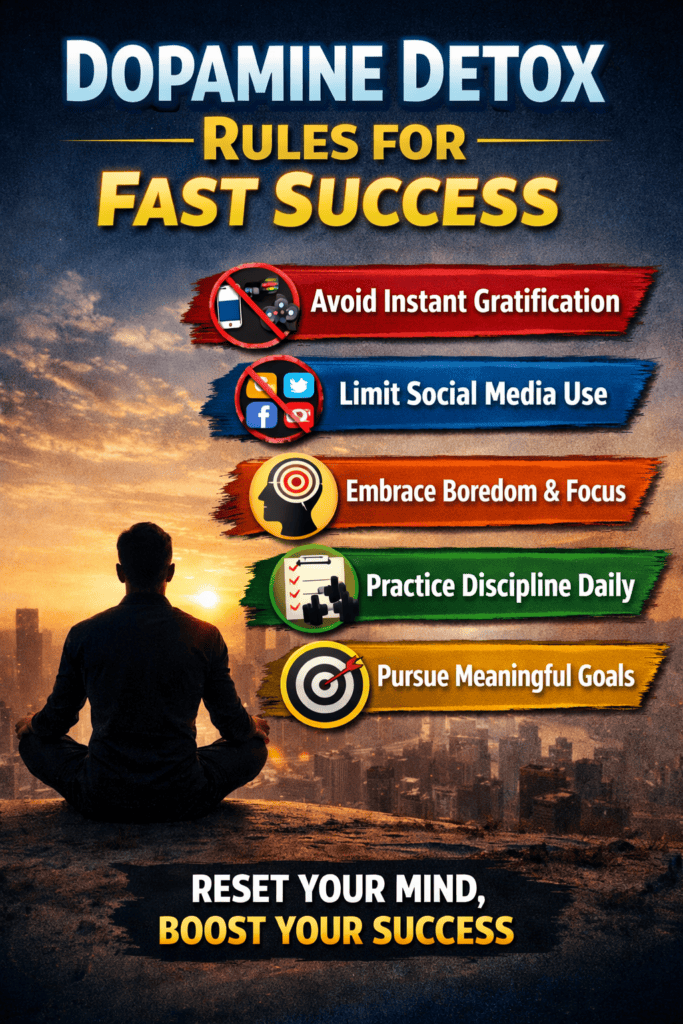
In this guide, you will learn the essential rules that make a dopamine detox effective, sustainable, and aligned with how the brain adapts to changes in stimulation.
The Science Behind Dopamine and Behavior
Dopamine is not just about pleasure. It’s a neurotransmitter responsible for motivation, reward, and habit formation. When your brain is constantly exposed to high levels of stimulation—social media, fast entertainment, or instant gratification—it starts to reduce sensitivity to normal rewards.
This means that simple tasks like working, studying, or focusing become harder over time.
According to research from Harvard Medical School, overstimulation can significantly impact your brain’s reward system and reduce your ability to stay focused on low-stimulation activities.
👉 https://www.health.harvard.edu/mind-and-mood/doomscrolling-dangers
What Are Dopamine Detox Rules and Why They Matter
Dopamine detox rules are not about restricting your life or eliminating all sources of pleasure, but about creating boundaries that reduce excessive stimulation and allow the brain’s reward system to stabilize.
Without clear rules, the process becomes inconsistent, which prevents the brain from adapting and often leads to frustration or the impression that the detox is not working.
Research related to behavioral regulation and reward systems, as discussed by National Institutes of Health, suggests that consistent patterns of behavior are essential for long-term neurological adaptation.
Rule 1: Eliminate High-Stimulation Activities Completely (At First)
One of the most important rules is to remove high-dopamine activities entirely during the initial phase, rather than trying to reduce them gradually, since partial exposure often maintains the same reward patterns and prevents meaningful change.
These activities typically include:
- social media scrolling
- short-form content
- pornography
- junk food
- constant digital entertainment
By eliminating them temporarily, you allow the brain to reset its baseline sensitivity without constant interference.
Rule 2: Do Not Replace One Addiction With Another
A common mistake is substituting one form of stimulation for another, such as replacing social media with endless YouTube videos or switching from one type of distraction to another that produces similar dopamine responses.
This prevents real progress because the brain continues to operate under the same reward-seeking patterns, even if the activity appears different on the surface.
The goal is not substitution, but reduction.
Rule 3: Structure Your Day to Avoid Idle Time
Unstructured time is one of the main triggers for relapse, as the brain naturally seeks stimulation when there is no clear direction or purpose.
Creating a structured daily routine reduces decision fatigue and minimizes opportunities for impulsive behavior, making it easier to maintain consistency without relying on constant self-control.
This includes:
- defining work periods
- scheduling breaks
- planning low-stimulation activities
Rule 4: Allow Low-Dopamine Activities (Do Not Go Extreme)
A dopamine detox is not about doing nothing or isolating yourself completely, as extreme approaches are often unsustainable and unnecessary.
Instead, the focus should be on engaging in low-dopamine activities such as:
- reading
- walking
- journaling
- deep work
These activities support the transition without overwhelming the brain.
Rule 5: Expect Discomfort and Do Not Interpret It as Failure
One of the most critical rules is understanding that discomfort is part of the process, especially during the first days when the brain is adjusting to lower levels of stimulation.
Feelings such as boredom, restlessness, or lack of motivation are not signs that something is wrong, but indicators that the brain is recalibrating.
According to insights from American Psychological Association, behavioral change often involves an initial phase of resistance before adaptation occurs.
Rule 6: Limit Exposure, Not Life
The purpose of a dopamine detox is not to remove enjoyment from your life, but to reduce excessive stimulation that disrupts balance.
This means that over time, you can reintroduce certain activities in a controlled way, as long as they do not dominate your attention or become compulsive.
The key is control, not restriction.
Rule 7: Focus on Consistency Over Intensity
Short periods of extreme restriction are less effective than consistent, moderate changes applied over time.
The brain adapts gradually, and maintaining stable patterns is more important than pushing yourself to extremes that cannot be sustained.
This principle is essential for long-term success.
Common Mistakes That Break Dopamine Detox Rules
Even with good intentions, many people fail because they misunderstand how the process works.
Some of the most common mistakes include:
- attempting to eliminate everything at once without structure
- expecting immediate results
- relying on motivation instead of systems
- returning to old habits too quickly
Avoiding these mistakes is just as important as following the rules themselves.
How to Apply Dopamine Detox Rules in Real Life
Applying these rules does not require a perfect environment, but it does require intentional decisions about how you use your time and attention.
A practical approach includes:
- removing the most disruptive inputs first
- creating a predictable daily structure
- gradually reinforcing low-stimulation habits
Over time, these adjustments become easier and more natural.
How Long Should You Follow These Rules?
The duration depends on your starting point, but most people begin to notice changes within one to two weeks, while more significant improvements occur after several weeks of consistent application.
Final Thoughts
Dopamine detox rules are not complicated, but they require clarity and consistency to be effective, since the brain responds more to patterns than to isolated efforts.
By focusing on reducing overstimulation, structuring your environment, and maintaining realistic expectations, it becomes possible to create lasting changes that improve focus, discipline, and overall mental clarity.
FAQs
What are the most important dopamine detox rules?
Eliminating high-stimulation activities, avoiding substitution, and maintaining consistency are the most critical factors.
Can I use my phone during a dopamine detox?
Yes, but it should be limited to essential use and not for entertainment or impulsive behavior.
Do dopamine detox rules need to be strict?
They should be clear and consistent, but not extreme or unsustainable.
Pingback: How to Calm Your Mind Fast: Practical Ways